
 STYLE & SELECTION / THE DISPATCH
The crown speaks first
Before anyone notices the ribbon, the edge finish or the handwork under the brim, the crown has already introduced the hat. It sets the vertical rhythm. It can look reserved or theatrical, familiar or strange, workmanlike or ceremonial. The brim may frame the face, but the crown tells the room how to read the silhouette.
That is why hat crown styles matter—and why their names are only a beginning. Teardrop, cattleman, telescope, porkpie, mule kick, Gus and open crown are useful pieces of vocabulary. They help a wearer and a hatter begin in the same place. They do not, by themselves, determine the finished design. Height, taper, pinch depth, crease width and the relationship to the brim finish the sentence.
Crown style is vocabulary, not destiny
A crown is the part of the hat that rises above the brim. In felt hatmaking, its final form is developed through blocking, steam and controlled pressure. Some hats are shaped to a named crease. Others begin open and are handled until a more personal geometry appears. Either way, the crown is not an isolated object: it changes when the brim gets wider, when the band moves higher, when the sides taper inward or when the front pinch is sharpened.
Two crowns can both be called teardrops and carry entirely different attitudes. One may be tall and spare with a long, narrow crease. Another may sit low and generous, opening toward the back. The label identifies a family resemblance. The proportions reveal the individual.
Teardrop crown
Viewed from above, a teardrop crown usually narrows toward the front and rounds through the back. A center depression and front pinches give it direction, so the eye travels forward. It is common in fedora language because it can be clean without feeling severe and expressive without asking for a great deal of ornament.
Change the depth of the front pinch and the whole mood moves. A tight pinch reads sharper. A softer pinch lets the felt carry more volume. Increase the crown height and the teardrop feels more vertical and dramatic; lower it and the same plan view becomes quieter.
Cattleman crown
The cattleman is a foundational Western crown. Its long central crease is flanked by two side creases, producing three raised ridges when seen from the front. The structure is clear and repeatable, which is one reason the profile travels so easily from working hats to dressier Western forms.
But a cattleman is not one fixed silhouette. A low crown can feel compact and contemporary. A taller version carries more presence. Narrow the center channel, deepen the side creases or change the front-to-back pitch and the hat begins to speak in a different register while staying legible as cattleman.
Telescope and gambler crowns
A telescope crown uses a circular crease around the top, leaving a recessed center and a raised perimeter. On a broad-brimmed Western hat it is often associated with the gambler silhouette. The geometry is calm, horizontal and architectural: instead of pulling the eye to a sharp front pinch, it distributes attention around the crown.
That circular logic makes small proportion changes easy to see. A higher side wall gives the hat more authority. A low, shallow telescope can feel relaxed. Paired with a wide, level brim, it becomes expansive; paired with a shorter or more animated brim, the same crown can become playful.
Porkpie crown
The porkpie is close kin to the telescope but usually lives lower. Its crown tends to be compact and flat-topped, with a tight circular crease around the upper edge. The short vertical scale is essential to the character. Put that crease on a much taller crown and the hat moves toward a different family, even if the top view looks similar.
Because the crown is low, the brim appears more assertive. A narrow brim can make a porkpie crisp and rhythmic. A broader brim exaggerates the contrast between the compressed crown and the horizontal plane below it.
Mule kick, Gus and deuce trey
Some Western crown names describe movement more than symmetry. A mule kick introduces a dented, kicked gesture into the crown. A Gus is recognized by its slope—often with a dramatic difference between its low and high points. The deuce trey belongs to this same useful territory of directional shaping, where the crown carries attitude through pitch, asymmetry and the placement of its creases.
These styles reward a side view. From the front, a crown may appear almost restrained; turn it a quarter turn and the rise, fall and compression become visible. The silhouette stops being a diagram and begins to feel like motion.
Open crown: possibility before commitment
An open crown is not unfinished in the careless sense. It is a crown intentionally left without its final crease. The form holds the height and circumference created by the block, but the top remains available for shaping. For a custom hatter, that openness is useful: it makes room to study the wearer, the felt and the intended brim before fixing a vocabulary too soon.
It also reveals something important about every named crown. The crease is not decoration placed on top of a neutral object. It redistributes volume. Every push creates a ridge somewhere else; every pinch changes the way light moves across the felt.
Height, taper and pinch change the sentence
When choosing a crown, start with proportion rather than category. Crown height changes the scale of the entire hat against the wearer. Taper—the degree to which the sides narrow toward the top—can make a crown feel neat and contained or open and commanding. Pinch depth controls shadow. Crease width controls how much of the top remains visible. None of these decisions acts alone.
Then look at the brim. The same four-inch brim can look moderate under a tall crown and immense beneath a low one. A sharp upturn can make a soft crown feel alert. A level brim can calm an animated crease. Crown and brim should be judged together, on the person, from more than one angle.
From the Dungeon: one tilted line
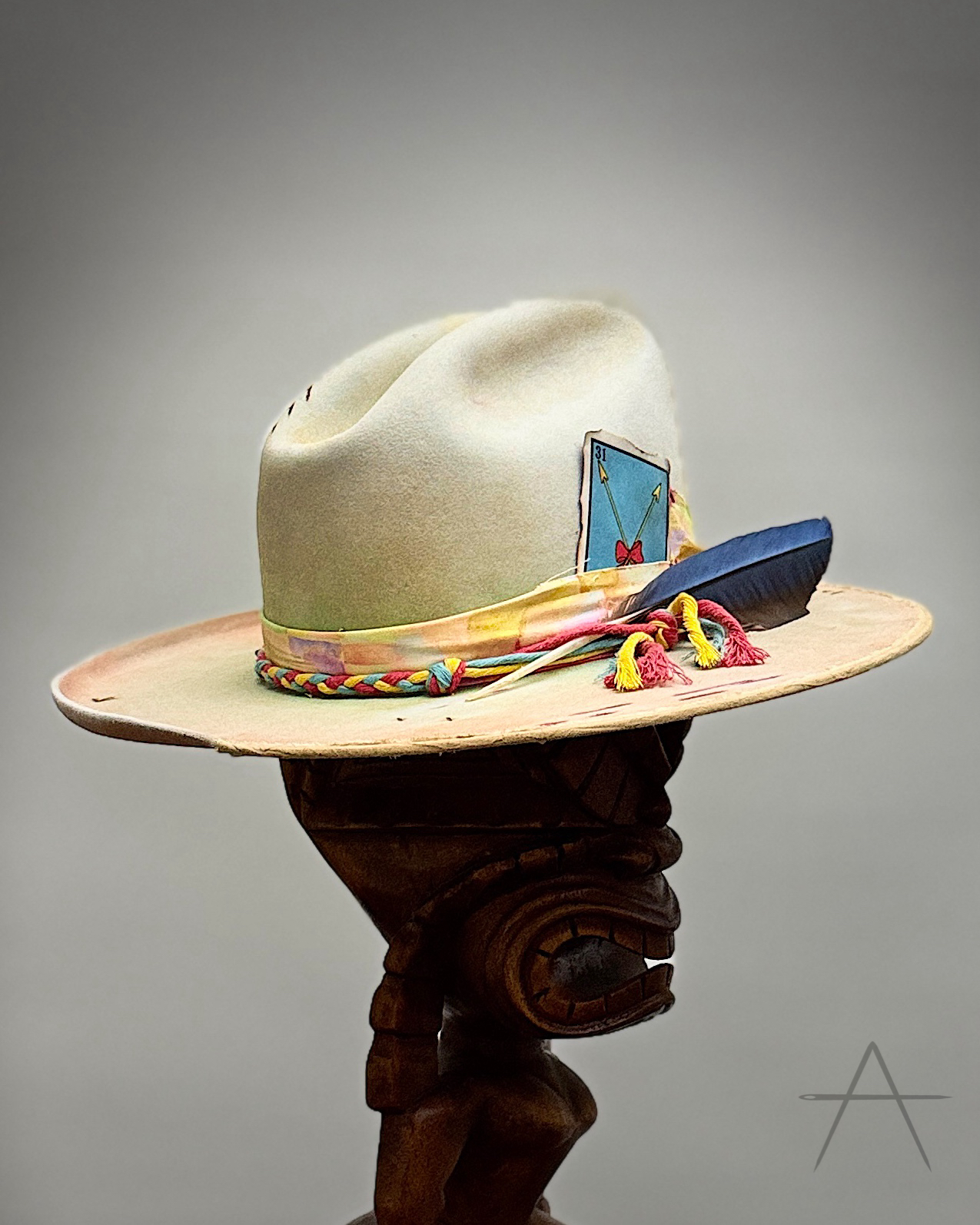
The current Amiga build makes the lesson visible. Its Freestyle Gus crown rises from roughly three and a half to five and a half inches across a deliberate tilt. The Western vocabulary is recognizable, but the crown line refuses a level horizon. That single decision changes the attitude before the painted brim, braided cord and small found elements enter the conversation.
The two-inch climb gives the hat direction. From one angle it feels familiar; from another it leans into motion. That is the difference between choosing a crown name and designing a crown. We kept the family resemblance, then changed the proportion that mattered most.
Under the brim
Crown height changes perceived brim width. Put the same brim beneath a tall crown and it often reads as restrained. Lower the crown and the brim suddenly looks broader, even though no measurement has changed. This optical relationship is one of the most useful tools in a custom consultation because it lets the hatter adjust presence without treating every dimension separately.
When you try on a hat, do not ask only whether you like the crown. Ask what the crown is making the brim do—and what both are doing to the scale of your face, shoulders and posture.
Choose the crown, then make it yours
Learn the names. They make references easier, preserve useful histories and give a custom conversation somewhere concrete to begin. Then learn when to break the rules. A good crown does not win because it is the purest example of a category. It works because its geometry belongs to the wearer and to the rest of the hat.
Bring us the crown you have always worn, the one you have never dared to wear, or simply the feeling you want the silhouette to carry. We can begin with teardrop, cattleman, telescope, porkpie, mule kick, Gus or open crown. The real design starts with what we change together.
Continue the process
Continue the story.